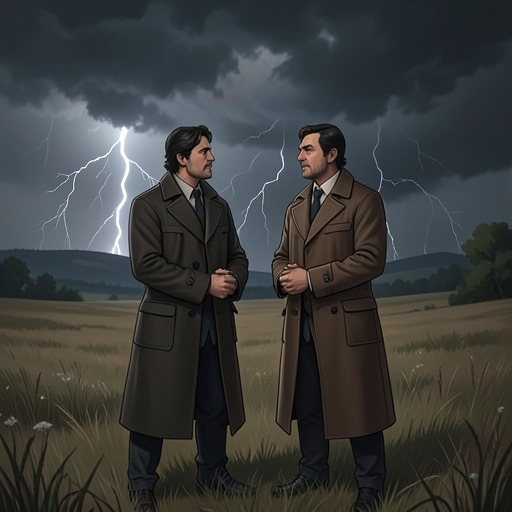
Arkham's Crane Street
The Colour Out of SpaceArkham's Crane Street is closely bound to Nathaniel Wingate Peaslee's disrupted life: the house he left during his sudden amnesia became the place where the unexplained interval in his identity first manifested and where, years later, he tried to resume his former existence. Its significance rests not on any described character of the street itself, but on the successive, sharply different lives gathered inside one home.
Setting and Peaslee's Connection
Peaslee was born and raised in Haverhill and moved to Arkham in 1889, at eighteen, to attend Miskatonic University. After graduating and studying at Harvard, he returned to teach at the university. His collapse came in 1908 while he was conducting an economics class; after he was carried home, he awoke without a remembered identity or past. The account places that home at 27 Crane Street, making the address the first domestic setting of the strange condition that had overtaken him.
The house could not restore continuity by itself. Peaslee's original faculties did not return for five years, four months, and thirteen days. When they did, the interval had to be reconstructed from other people's accounts, and the familiar home became part of a life that its returning occupant could no longer simply take up where he had left it.
The Reopened House and the Strange Mechanism
In the summer of 1913, Peaslee's altered personality began to show flagging interest and spoke of a coming change. Around the middle of August, it returned to Arkham and reopened the long-closed house on Crane Street. There it installed a small, unusual mechanism assembled from parts made by different scientific-instrument makers in Europe and America. Witnesses described a mixture of rods, wheels, and mirrors, about two feet in each dimension, with a circular convex mirror at its centre. The device was carefully kept from anyone capable of analysing it.
The house's nighttime activity sharpened the uncertainty surrounding the change. On September 26, its lights remained on late; a lean, dark, foreign-looking visitor arrived by automobile, and the lights were last seen around one in the morning. A policeman saw the house dark at 2:15, while the visitor's motor remained at the curb; by four, the vehicle was gone. At six, a hesitant foreign voice telephoned Dr Wilson and asked him to come to the house because Peaslee had fainted. The long-distance call was traced to a public booth in Boston's North Station, but the visitor was never identified. The house thus holds both the physical evidence of the altered personality's activity and the unresolved departure that preceded Peaslee's return.
Return and Narrative Significance
When Peaslee's original consciousness came back, its sense of time remained fixed at the Thursday morning in 1908 when the economics class had been interrupted. Re-entering ordinary life was painful and complicated. After regaining custody of his second son, Wingate, he settled with him in the Crane Street house and tried to resume teaching, beginning with the February 1914 term. The same home that had been reopened and fitted with an unexplained device therefore became the setting for a practical, difficult attempt at domestic and professional recovery.
Crane Street links the story's two incompatible versions of Peaslee without resolving how the exchange occurred. The house is first encountered through reported traces—its carefully concealed apparatus, lights, visitors, and telephone call—and later through the returned man's attempt to inhabit his former life. Its ordinary domestic function contrasts with the extraordinary interruption contained within it, while its recurrence gives the lost years a concrete address.